
The program covers the field from the essentials in Bioinformatics, to advanced levels of Bioinformatics technology with projects showcasing the acquired knowledge.
Program structure
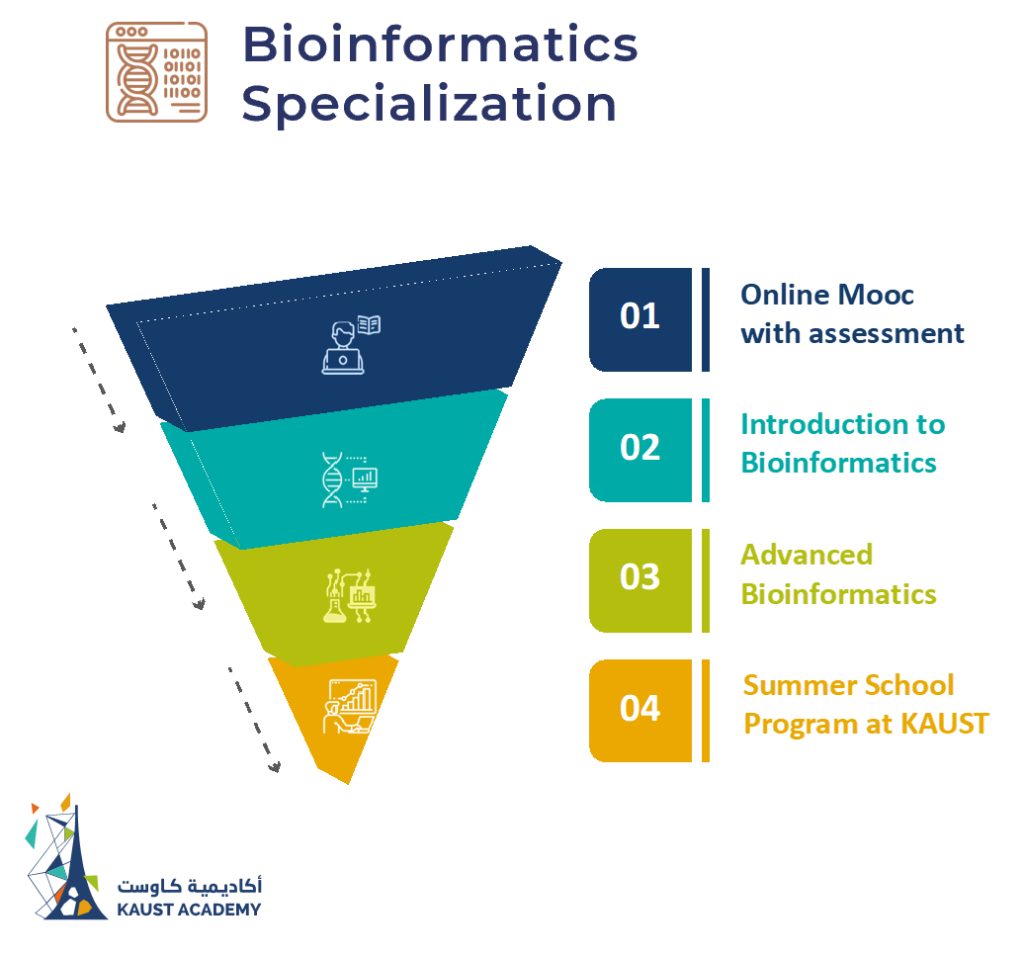
Stage 1: Prerequisite course
Important note: Signing up for the prerequisite courses on Coursera (Stage 1) does not guarantee participation in subsequent stages. Students must demonstrate their knowledge and skills by excelling in the assessments to progress through the program. Certificates of completion will be awarded at each stage to acknowledge participants’ achievements. Qualified students will be invited to the next stage.
Duration: 2 to 4 weeks Completion date: Early November Method: Self-paced, online courses
Description: The students are required to complete 2 auto-enrolled course on Coursera, supplying them with the knowledge for Bioinformatics essentials and building blocks.
Stage 2: Introduction to Bioinformatics
Duration: 5 days Start date: During university breaks 2026/2027 Method: Instructor-paced, in-person lectures
Description: Top qualified students will delve deeper into the world of Bioinformatics, learning the skills and tools to apply this newfound knowledge in their fields. The program will cover a wide range of topics, including Introduction to Bioinformatics and Biological Resources, Sequence Alignment and Phylogenetics, Genomics, Metagenomics, and Transcriptomics, and Proteomics and Structural Bioinformatics, equipping students with the expertise needed to address complex biological challenges.
Stage 3: Advanced Bioinformatics course
Duration: 4 days Start date: During university breaks 2027 Method: Instructor-paced, in-person lectures
Description: The qualified students will delve even deeper into the world of Bioinformatics, learning about advanced theories and applications of bioinformatics technologies. The program will cover specialized topics such as Advanced Genomics, Advanced Transcriptomics and Epigenomics, Systems Biology and Network Analysis, and Machine Learning in Bioinformatics, providing students with the tools and knowledge to work on cutting-edge research and solve complex biological problems.
Stage 4: Bioinformatics Summer Program
Duration: 8 weeks Start date: June 2027 Method: Instructor-paced, in-person lectures
Description: Qualified students will be invited to the prestigious KAUST Academy Summer Program in one of KAUST Academy top partner institutions in KSA or abroad. Students will be provided with on-campus accommodation and privileges.
What you’ll learn
Topics covered
- Basics of R
- How to analyze bulk RNAseq Count Data
- Basics of Python
- How to analyze single cell RNAseq count data
Skills you’ll gain
- R Basics
- Bulk RNAseq Analysis
- Linear Algebra
- Python Fundamentals
- Data Visualization
- Statistical Analysis
- RNAseq Techniques
- Python Coding
Requirements

Who can apply
- You must be a university student currently enrolled in a university, or recently graduated within two years.
- The accepted applicants’ age range is between 18 and 30, inclusive.
- You must complete the prerequisite courses on Coursera.
- Passing the assessments at each stage. Top qualified students will be invited to the next stage.

Placement test
Eligible candidates will be invited to the placement test.
To be eligible for the placement test, the candidate must be enrolled in the KAUST Academy/Coursera program within 3 days of receiving Coursera invitation and then complete the required prerequisite courses within the recommended period, otherwise the Coursera subscription will be revoked and passed on to other applicants on the waiting list.
How to apply
To qualify for the Bioinformatics Specialization, you’ll need to sign up for Coursera within 3 days of receiving the invitation link at your registered email address, and then successfully complete the following courses to be eligible to take part in the placement test:
Fundamental Skills in Bioinformatics
Python Programming Essentials
Hands-on Introduction to Linux Commands and Shell Scripting
Students with top scores in the placement test will receive invitation for (Introduction to Bioinformatics) to join a one week in person training during university breaks. At the end of the course, students with top performance will be invited to another one week in person training (Advanced Bioinformatics) and take an exam at the end of the course as well.
The top qualified students will receive invitation to participate in a variety of KAUST Academy Summer Programs at elite partners institutions in KSA and/or abroad including Summer School, Internships, and Research Programs.
Students who will not be selected after passing the placement test in December, will still have access to over 200 courses, specializations, guided projects and more on Coursera until August 2027. They will be eligible to receive a free certificate for each achievement on Coursera during that period.
Recommended agenda for Stage 1
Below you can find a recommended agenda to complete the prerequisite courses to be invited to the placement test and advance in the program.
| Week 1 | Module 1 | Introduction to Programming (using R) |
| Week 1 | Module 2 | Introduction to Programming II (using R) |
| Week 2 | Module 1 | Programming Python |
| Week 2 | Module 2 | Bioinformatics case study – RNA-seq bulk and single-cell data analysis |
| Week 3 | Module 1 | Hands-on Introduction to Linux Commands and Shell Scripting |
| Week 3 | Module 2 | Hands-on Introduction to Linux Commands and Shell Scripting |
Professor’s take on the course
“Bioinformatics brings together ideas from biology, mathematics, engineering and computer science to answer questions about complex biological systems. Using advanced ideas from statistics and machine learning to deal with huge data sets, these ideas are fundamental to the future of personalized medicine.
This course aims to bring together the brightest students from across the kingdom to work with leading scientists from across the world. Working with cutting edge tools and real world data sets, students can expect to be prepared for progressing into research in one of the fastest growing and most innovative areas of modern science.”
Professor Paul Fannon
Assistant Professor in Mathematical and Computational Biology
University of Cambridge

FAQs
Who can apply for this program?
- You must be a university student currently enrolled in a university, or recently graduated within two years.
- The accepted applicants’ age range is between 18 and 30, inclusive.
- You must complete the prerequisite courses on Coursera.
- Passing the assessments at each stage. Top qualified students will be invited to the next stage.
How do I start this program?
By signing up and completing the prerequisite (online) courses via Coursera.
Is there a tuition fee for the KAUST Academy Specialization Program?
The program is currently offered with a full scholarship for talented students at all Saudi universities.
Is this course only for technical professionals?
No, this training program is catered to Saudi students and recent graduates in Saudi universities to well prepare them for the ideal career opportunities in the Kingdom and/or abroad.
Will I be able to apply bioinformatics concepts in real-world scenarios after this course?
Absolutely. Yes, you will be equipped to apply bioinformatics concepts in real-world scenarios after completing this course.
How much time should I dedicate to the course each day?
(Stage one) Prerequisite online course is self-paced, suggested completion time is 2 to 4 weeks.
(Stages 2, 3, and 4) Introduction, Advanced, and Summer Program) are full day in-person training and instructor-paced. They will will take place during university breaks.
How do I get invited to the placement test in stage one?
To qualify for the placement test, you are required to successfully complete only the prerequisite course(s) which are auto-enrolled to your access upon joining Coursera.
Will I receive a certificate upon completion?
Yes, participants who successfully complete the online course(s) and/or the in-person courses will receive a certificate of completion to showcase their newfound knowledge and skills at each stage.
How do I qualify for the in-person training and reach the fourth stage (summer program)?
The program consists of four stages with assessment after each stage to get qualified to the following one. Top performing students will be selected to advance further until they successfully reach the summer program.
How could I benefit from this training program if I could not get selected to the in-person course?
Students who successfully complete the prerequisite courses on Coursera will be already benefited from this program even if they do not get selected to the second stage.
Do not forget that you have free access to over 200 courses, specialization, guided projects, and more through the KAUST Academy/Coursera license.
We strongly recommend that you enroll, complete and earn free certificates for as many courses as you like, during the entire period of the program.